
“Our admiration of the antique is not admiration of the old, but of the natural”
-Ralph Waldo Emerson
Our honeymoon was spent in Door County Wisconsin. Cherry country. We were young and broke, our whole lives in front of us. While most people think of tropical get-a-ways and white sand beaches, our honeymoon was spent in a stately mansion built in 1902, touring u-pick orchards and roadside antique shops scattered about the Wisconsin countryside. I suppose that’s where it all begin. A love for things forlorn.
Our first home was a foreclosure. A house badly needing a little vision or a bulldozer. We chose to see beyond its current state and make it work for our new family. It was home for 7 years. Our current home, a farmhouse built in 1910, was constructed on a field stone foundation and had seen better days. It has been home to several families throughout the past century and according to our neighbors, at lease one previous owner was advised to tear it down and start over. They didn’t and we didn’t either. We restored it piece by piece. It’s home. A place to rest. A place to be still. So, I guess it wasn’t entirely a shock to us that we would be wooed by something historical. An antique. A hand-hewn cabin built in the mid-1800s. Forlorn.
Amazed by the natural beauty of this farm we purchased last fall, we both agreed, if we were to ever do anything on this land, it had to enhance the beauty of the landscape, not take away from it. In all of our planning and discussing we couldn’t ever quite get comfortable with the idea a “new” building. Fortunately in our wondering, we came across someone selling an old cabin in Missouri, and immediately we felt “This is it!”.
Log homes are not as common here in Central Iowa, with open plains and prairies dominating our historical landscapes. Sod homes were more prevalent. Further south, in heavily forested areas, log homes were a quick way to establish a presence for new settlers. They were rudimentary and as basic as possible. Log structures were built relatively quickly by felling trees, stripping them of bark, flattening the sides using tools only found in antique shops, and then stacking each log one on top of the other. Siding would later be added once the family became established and could afford to do so.
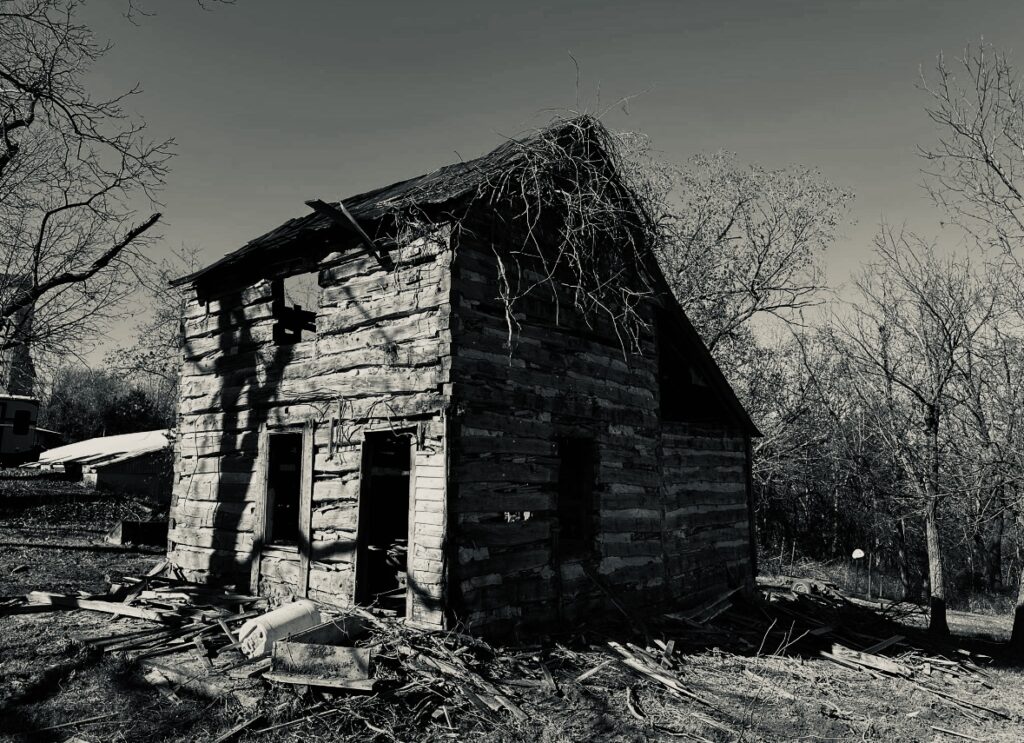
The cabin (pictured above) was home to several families in St. Elizabeth, Missouri, a small town in Central Missouri. Likely built by German settlers, this cabin had siding that was peeling, broken and dingy, but beneath the beaten exterior of this small house, something beautiful. Logs.
The cabin would then be measured, each log tagged and labeled, like a completed puzzle ready to be placed back into its box. Ever so carefully, each one was then removed one log at a time. Piece by piece. Log by log. The logs were loaded onto a trailer and delivered to us late last fall. We stacked them, and tucked them away for winter beneath a tarp.
And so here we are. The rebuild set to begin soon. Unlike traditionally built structures, these cabins require plenty of unconventional building techniques and plenty of patience. A marathon, not a sprint. Step by step. Log by log. The vision? A simple log cabin, nestled into the rural hillside, overlooking a farm pond, while catching a sunset. A place to be still.


Leave a Reply to Frances Hamilton Cancel reply